The Best Fluffy Pancakes recipe you will fall in love with. Full of tips and tricks to help you make the best pancakes.


The Bestocian Nation
Read time
30
minutesThe Story
The Bestocian empire is torn to shreds by social, economic, and moral crises unprecedented in scale or scope. Yet its citizens remain united in pride that it is the best empire ever to exist. They maintain an immutable belief that it is the Bestocia it has ever been.
A little less than two centuries ago, Bestocia proclaimed its independence as an empire, independent of the fact that its land was not, and has never since been, severed by ocean or sea. And although the Bestocians conquered the land under heavy artillery, they frequently articulate reminders to one another, that Bestocia has existed since the beginning of time, and will exist forever.
Today’s Bestocians are merely the great modern endless end of a single, singular, and infinite national bloodline. The Bestocian history has no beginning or end, but in order to narrate it, one must start with the ancient Bestocian tribes—who called themselves different names than today’s Bestocians, spoke different tongues, wore different clothes, ate different foods, sang different songs, and believed in different stories. Like all other nations that have naturally existed since the beginning of time, they planted and plowed, traded wheat for fabric to stay warm, and gladly offered much of their harvest—cultivated with sweat and blood—in exchange for security.
The giver and taker of security was a king. He was no ordinary king; he was the great Bestocian king. And although his subjects only ever saw his face engraved on metal coins, they knew wholeheartedly that he was a unique man of unprecedented and inimitable bravery and compassion, sanctioned to rule by no other than God’s Ministry of Geopolitical Affairs. To be more certain of this, the ancient Bestocians had the testimony of poets and shamans who lived lavishly off the scraps from the king’s table.
Even though the ancient Bestocian king shares nothing with today’s Bestocians, and little even with the Bestocians of his own time, — not in dress, diet, or dialect — this is no cause for lament; He remains the great king of both. They carry him in their hearts, in their pockets, and sometimes on their hats, and through him, they too are made great.
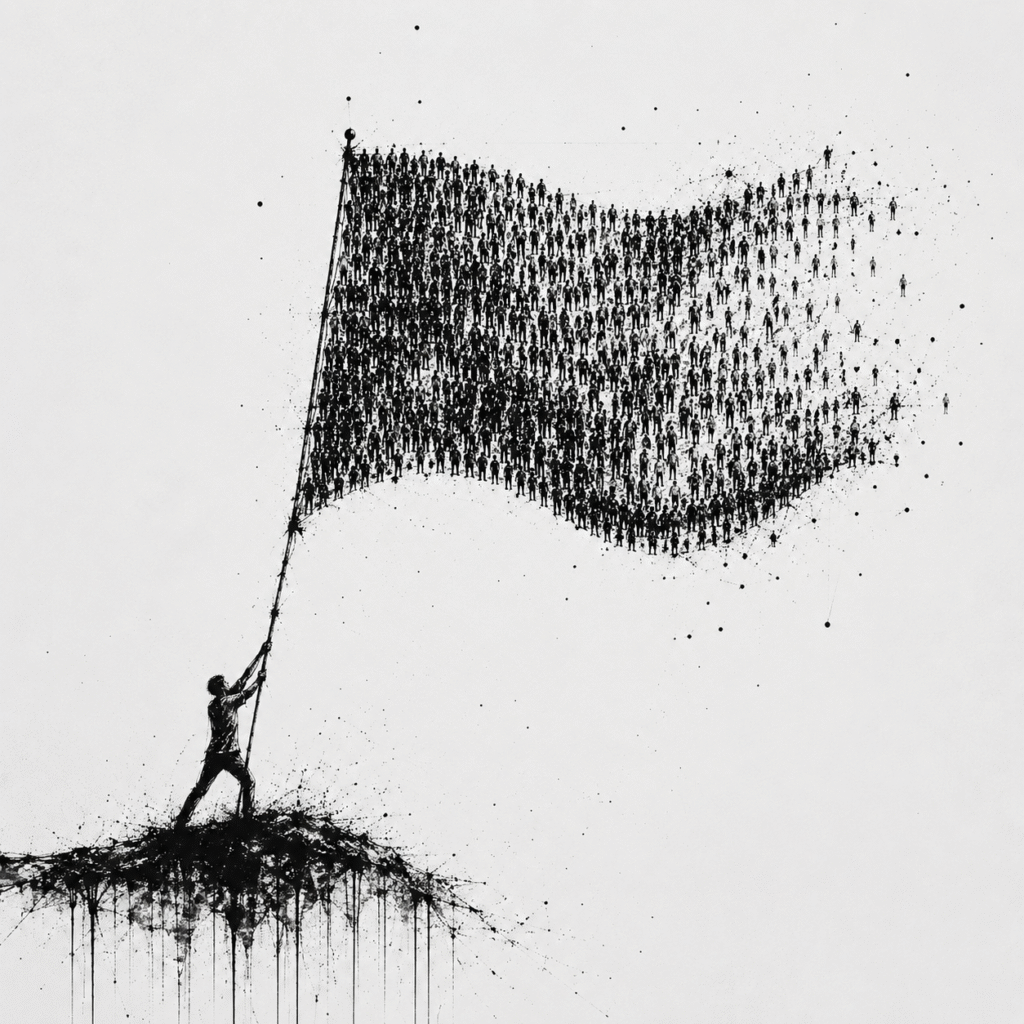
Back to the present: things in Bestocia are as unstable as the height of the flag flung on Great Bestocia’s Independence Day. Economic depression is ravenously eating away at people’s hopes of keeping bread and books on their children’s tables. The political divide between the Futurists and the Presentists is drawing a wedge straight through the heart of the nation. Although the two parties agree on almost everything except for minor issues, they fiercely disagree that they agree on major issues, creating two cults of nearly identical opinion. The apps developed in recent years for everything from work to mating to making friends, are growing more expensive, generating a vicious cycle of unemployment and blue balls. Both are fuelling the wave of violence currently flooding the Bestocian streets, a wave mostly attributed in the media to the frequently co-occurring diseases of laziness and brown skin.
But none of this matters—because it’s Independence Day! The flag is flying high, and morale is even higher. And the solution to unity, prosperity, and even moral superiority is simple: all the Bestocians have to do is stand together against the Worstocians.
The Worstocians are the Bestocians’ neighbors. They have an ancient king and a God of their own, along with myths and legends that stretch into the past, and aspirations that reach toward the future. But their king, their God, their myths, and their dreams all contradict those of the Bestocians—and that makes them terrorists. Especially because they are too poor to do business with.
Terrorists, of course, must be wiped out—kicked from their homes, their vast swaths of fertile, resource-rich land seized and put to proper use. It is a moral imperative. Even more so because, thousands of years ago, Bestocian tribes once inhabited that land, before leaving under tragic circumstances that still echo in the hearts of today’s Bestocians, filling them with rage and a thirst for vengeance.
And when their minds are distracted by economic fears, poor government management, and social division, the Bestocians hearts are guided back to the righteous path of hate by their leaders. These leaders are a legal embodiment of the essence of Robin-Hood, as they fund their political campaigns with money from the richest elites, yet somehow spend their time serving the people.
The Supreme Leader stood tall at the Independence Day podium — a pillar of hope — and with his words armed and fired the crowd’s passion. Just two months before a neck-and-neck election, he delivered a magnificent speech celebrating democracy, announcing that he would give the people what they wanted. They would no longer have to endure the ancient injustice inflicted by the Worstocians. They were going to war — to purge the world of evil, to purge the warehouses of stagnating armaments, to make room for the People of the Light, and for a healthy, booming economy of military production — one bullet at a time.
The Bestocians heard the speech and grew confident that although they would drop the first bomb, it was the Worstocians who had cast the first stone — thousands of years ago. A stone yet to be uncovered by archaeologist, but one still fresh in memory and scripture.
As the war raged, the Worstocian land grew only more fertile with every drop of blood it absorbed. The land was baptized in gunpowder and cloaked in smoke — the veil of a bride awaiting her new mate. The smoke grew so thick it often obscured the magnificent view savored by zealous Bestocian children, who sat atop hills to watch justice fall from fighter jets onto Worstocian children.
The losses of Worstocian children were reported only in few foreign media, where cold numbers and steep graphs served as mass graves for their untold stories. The losses of the few Bestocian soldiers, however, were told in tragic tales on a background of weeping violins — and brought the world to tears.
Those tears melted the Bestocian differences of ideology, ethnicity, and faith, into a single pot of national memory. The more they wept, the more their grief flowed like needle and thread— stitching together a fictional fabric of the past, to be worn, proudly, into the future.
Discussion
- Our ancestors spent much of their time chasing the next meal. Fast forward to a time when the next meal seems almost to be chasing us, and we spend most of our times looking for ourselves. And we may find ourself in a multitude of places. We may find ourselves in the company of close friends or family, when engaging in satisfying work or a creative endeavor, when taking care of our children, or when making Mom and Dad smile. Many of us, consciously or unconsciously, find ourselves in belonging to a nation. eam chocolate bar donut
- One of the challenges of the social sciences is that their vocabulary is never entirely static. Unlike the molecule of water or the geometrical triangle, human values, institutions, and practices evolve. And so, the words used to describe them may remain in use even as their meaning changes. This can give the illusion that, if the word was used centuries ago, then the thing it is used to describe today must have existed back then in the same form. The nation is no exception. Depending on the historical period and context, the word nation could refer to a group of people who spoke the same language or dialect, shared a geographic origin, or presumed a common lineage. Today, the word refers to something profoundly different. One of the most influential modern definitions come from the political scientist Benedict Anderson. He defined the nation as “an imagined political community – and imagined as both inherently limited and sovereign” [1]
- Beneath the simplicity of Anderson’s definition lies remarkable sophistication. It lays out a sequence of conditions a group must meet to become a nation in the modern sense. The first is imagination. The word “imagined” is used not in contrast to “real” but to face-to-face communitties. A member of a nation will never even hear of most of the millions of his fellow nationals, let alone meet or befriend them. And yet he may donate or pay taxes to help – ideally – the less privileged among them, mourn when catastrophes befall them, delight when they win Olympic medals, and even die in battle to protect them. What is most striking is that people may bear a similar sentiment to their nation, and sacrifice to a similar extent on its behalf, as they do for their oewn family and friends. And yet in contrast to nations, family and friends are face-to-face communities whose members we know by name, appearance, and specific attributes, and with whom we do not usually share a dream of establishing a sovereign state. It is precisely because face-to-face relationships cannot encompass all its members that the nations is an imagined community.
- But the imagination of a common present isn’t enough. A nation has not only to feel as one but act as one. It must have institutions with the authority to make collective decisions on behalf of all its members – and to bind them to those decisions. The international scientific community, for example, is most certainly an imagined community. It includes millions of members who identify with one another, cooperate, share common values and a love for discovery and truth, and publish in the same journals. But they do not a have a system for collective decision making that binds scientists just because they are scientists. The international scientific community cannot force its members to boycott a company or risk their lives fighting Ebola in Africa. It cannot enforce a taxation system, appoint some as scientists or rid others of the title. And so it lacks the second condition in Anderson defintion, being a political community.
- But being imagined and political doesn’t yet touch the essence of the modern nation. Authority alone is not enough. The crucial question is where that authority derives its legitemacy. The catholic church includes millions of members who share an identity and values, and at certain periods of its history it was – regretably – very political. For centuries the Pope ruled the Papal states, which involved a clear hiereachy of power at the top of which sits the Pope, and under him are bishops, cardinals, priests, all organized within administrative institutions. It also had its own binding legal system and courts that regulated many aspects of the members’ life from marriage to property. It even involved its own taxation system and army, and conducted diplomacy as one political unit with other states. But there is one important distinction that prevented the catholics from forming a nation – sovereignty. This is the third, and perhaps the more subtle, condition for nationhood, but it is most crucial to understand the modern nation. The Pope’s authority was understood to come from God and not the members of the church. The source of his legitimacy as leader is teh belief that he is fulfilling God’s word and not the will of the People. It is only when the group views itself as sovereign, and develops an agenda for self-determination, a desire to govern itself within a state of its own, does it become a nation. The idea that sovereignty belongs to the people is surprisingly recent, for which 17th and 18th century thinkers such as John Locke and Jean-Jcques Roussaeu laid the foundation, andonly became a recognized international law in 1918.
- But perhaps the most enigmatic of three words in Anderson’s definition, one that resists confinement within the borders of the sociology discipline, is the word community. What brings about the feeling of connectedness in the evermore individualized modern world? How can a bond transcend geography, survive the fragmented modern mind, and remain strong enough to bind millions?
- The national bond strikes the soul with a singular flavor. Yet, much as a carefully crafted dish, the national bond is the product of several ingredients each added at just the right time to infuse properly. And they start infusing early. Babies enter life eager to absorb their mother’s milk – and their mother tongue. Schoolchildren enter history class as the sons and daughters of their parents, carrying little more than fragmented memories of breakfast teh ride to school, and leave as the proud descendants of heroes, kings, prophets, philosophers, and revolutionaries, who adorn a vast, all-inclusive family tree. Their triumphs and tragedies form centuries’ worth of shared memories newly added to the children’s past. Then the past really comes to life on national holidays, when family and friends gather in synchrony with millions of their fellow citizens – in dress, food, and custom – to mourn the sufferings and celebrate the victories of their shared past. They are then reprieved from school on Independence Days, only to continue their national education as they march hand in hand to the sound of drums, under hoisted flags and fireworks, chins lifted, reciting the national anthem with hands over their hearts. But a final ingredient remains for the national flavor to fully mature – wine. When children become adults, they may seek romantic relationship, but they also enter a new relationship with their nation. They are no longer bound solely by a common history, but by the shared rights and duties of citizenship. As citizens, they participate in the same economy, stand equal under the same law, consume the same news, and – hopefully – seek representation in the same parliament. By inhabiting a common present, and shaping together a common future, the national bond that unites them ripens.
- Just like embryos form in nine months what evolution built in millions of years, the national identity that forms during a human lifetime took half a mellenium to evolve. The past century has seen formiddable effort to reverse engineer the evolution of nationalism.
- Benedict Anderson offered one of the most influential explanations of how loyalty and community extended beyond the boundaries of face-to-face contact. Anderson explained how even without meeting, people can imagine themselves living the same story. His answer was simple yet as sharp as black ink on a white page; the invention of Gutenberg’s printing press in the 15th century enormously increased the number of books and readers, but it decreased the number of dialects. The hundreds of local dialects Europe had at the time meant that printers had to make hundreds of different versions of each book, which meant less profit. And so they favored certain dialects over others, which later became standardized in grammar and spelling by scholars, a process that eventually produced the national language we know today. The implications cannot be overstated. One common language allowed one national conversation. Newly built railways meant that people in Paris, Lyon, and Marseille read the same morning newspaper, and thus mourned together the fallen soldiers, debated together the new law, and celebrated the birth of a republic. Instead of remaining captive to their local events they were now interconnected like nerve cells of a single national brain.
- If Anderson’s answer to the quesiton of nationalisation was black print on white pages, Ernest gellner’s answer was white chalk on blackboard [2]. Gellner, a philosopher and political anthropologist, described how the industrial revolution necessitated a mass education system, and how education dissolved local differences in dialect, custom, and identity. In the agrarian system, before the inducstrial revolution, the vast majority of people were peasants. Their occupation, their lifestyle, and even their social status that came with it, were as immutable as the land they worked. They inherited their land from their parents, were bound to it till their death, and passed it on to their children. With the advent of machinary, less people were required to plow the land, and more work opportunities opened up in cities, that recieved massive influx from local peasant communities. For the economic system to be efficient, these peasants needed to cooperate, to move both horizontally between jobs and vertically within the hierearchy of the factory. To this end schools were built teach them the same language, the same baseline knowledge, the same geography, and the same legal system. But, and this is Gellner’s greatest insight, schools created more than a common body of knowledge; they cultivated a shared high culture – common language, common symbols, common civic knowledge and values, and a common national history. And so, by making strangers interchangable at the factory, they stopped feeling like strangers, and became imaginable as one people.
- If Gelner’s welding together of peasants involved wokring together towards a common end, Anthony D. Smith [3] argued that to make a nation you must teach them a common beginning. Smith, a sociologist and professor of ethnicity and naitonalism, understood that common knowledge isn’t enough to create loyalty and community. Brothers can disagree on just about everything, they can grow up and take enirely different paths in life, and yet they retain the bond of brotherhood because they come from the same place, from the same blood. Schools can teach history and culture, but they can’t create them from nothing, and this is where national historians become important. Historians draw upon older myths’ memories, symbols, and tradition that give the nation emotional depths. They provide the nation its past, adorned with heroes, sacrifice, and endurance in the face of suffering, and anchored in the ground, in the sacred homeland. This past give the nation a strong feeling of continuity and legitimacy. It is where symbols and culture and tradition can derive meaning. And it is where poets find inspiration to glorify the nation, to make serving one’s country serve one’s ego.
- Smith admitted, however, that historian is closer to a painter than a photographer. History is not not written by passively funnelling the past into a readable text, but by actively interpreting its events and weaving them into a coherent narrative. In writing a national history, the historian chooses which events to emphasize, how to frame them, and how to present the nation as the central thread of story.
- Modern constructivist historians psuh this further, and argue that that nationalising history involves more than mere interpretation. They don’t claim that national historians fabricate history, but that they project the language and imagination of today onto the events of yesterday. Historians such as Shlomo Sand [4] and Ernest Renan [5] criticism of national history making reminds me of a psychological exercise called Thematic Apperception Test. In this excercise the patient receives a set of cards with different scenes, and asked to choose some of the cards and assemble them into a coherent story. The story at the end reveals more about the patient’s subconscious than about the cards themselves. Likewise, the national narrative reveals more about the aspirations, anxieties, and identity of today’s nations than the past it seeks to explain. In reality, the past is chaotic and discontinuous. A certain territory will have wittnessed different kingdoms, different religions, and different dialects. History is full of wars that changes and rechanges its ruling power, that shapes and reshape its borders. History is full famines and disease that cause immense migration, that mixes and remixes the population. And most importantly, history has mainly seen people that either identify with the earth they plow, with the sword they weild, or with the territory and people over which they have dominion. But the modern historian unites these people into one nation, gives them one identity, gives them a golden age, a period of sufering and great endurance, and evetually a ressurrection. The national historian chooses events, kingdoms, religions and plots them on one continuous narrative that gives the modern nation a common origin and sense of legitimacy – to stretch the nation as one continuous arrow deep into the past so that it may fly far into the future.
- Erick Hobsbawm, another constructivist historian, argued that national traditions are often more modern and regional, but are made to appear ancient to give the nation the aura of antiquity. Just like a dialect that belonged to a specific region is nationalized, a traditional garment that belonged to a small clan become the national tradition garment. A festival that belonged to the royal family becomes a national festival. A folklore song once sung in a small village becomes the national anthem. By speaking the national language, participating in national ceremonies, and wearing tradition clothing in national festival, the national feels a connection to an imaginary ancient group of people that did the same. This illusion strengthens the national identity and gives it meaning, a sense of timelessness and continuity.
- The inevitable question that arises is this: what are we left with at the end? Is the product of the last half a mellenium a Drekylian monster that disguises as human in the day and wages war in the night, or a sour pill that promotes cooperation but comes with a side effect of xenophobia? Is the product of print, schools, historians, poets and revolutionaries, a community or a cult?
- My take is the following. When we anchor our nationality in the present and future, we create a community. When we feel a sense of belonging to our fellow nationals because we belong to the same democracy, we create a community. When we feel solidarity to all those who are equal in citizneship, equal under the same law, and represented in the same parilament, we create community. When we actively cooperate with our fellow nationals for the common good, despite our difference in opinion, religion, and sexual orientation, we create community. But when we anchor our nationality in the distant past, we create a cult. When we believe that what unites us is a common origin, we create a cult. When we believe the myth that we share one national history, with one distinct religion and a pure race, we create xenophobia and war. When we forget that at the end, we are all fragile creatures roaming the universe aboard a tiny spaceship called Earth, we become more nationalistic than human.
Bibliography
- 1) Anderson, B. (2006). Imagined communities: Reflections on the origin and spread of nationalism (Rev. ed.). Verso. (Original work published 1983)
- 2) Gellner, E. (1983). Nations and nationalism. Cornell University Press.
- 3) Smith, A. D. (1986). The ethnic origins of nations. Basil Blackwell.
- 4) Sand, S. (2009). The invention of the Jewish people. Verso.
- 5) Renan, E. (1990). What is a nation? In H. K. Bhabha (Ed.), Nation and narration (pp. 8–22). Routledge.
- 6) Hobsbawm, E., & Ranger, T. (Eds.). (1983). The invention of tradition. Cambridge University Press.